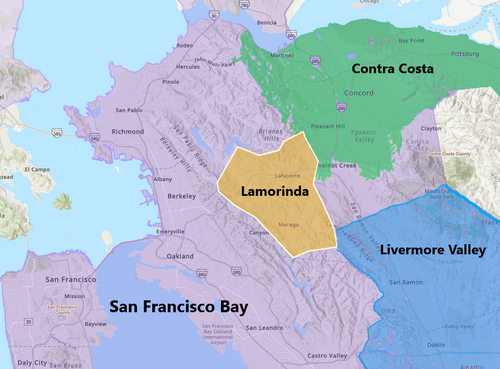
The Lamorinda viticultural area roughly encompasses the cities of Lafayette and Orinda, and the town of Moraga. The area takes its name from a commonly used portmanteau derived from the three names: “La” (Lafayette), “mor” (Moraga), and “inda” (Orinda). The area occupies the hilly-to-mountainous terrain between the Hayward Fault and Calaveras Fault and is unique to coastal California. Viticulture is largely limited to the hills where local microclimatic conditions are dictated more by terrain than by coastal influence or lack thereof. A unique geologic history has led to younger sedimentary rock, exposed by later uplifting, than what is found in surrounding areas. Further, occupying an area that could be described as semi-rural suburban, vineyards are small, with no one vineyard currently larger than five acres.
While Lamorinda is part of both the San Francisco Bay and Central Coast AVAs, Lamorinda is truly unique from other areas within those larger more generic AVAs. Lamorinda experiences more of the moderating effects of coastal air out of the San Francisco Bay than the adjacent Contra Costa AVA to the east or the Livermore AVA to the south.
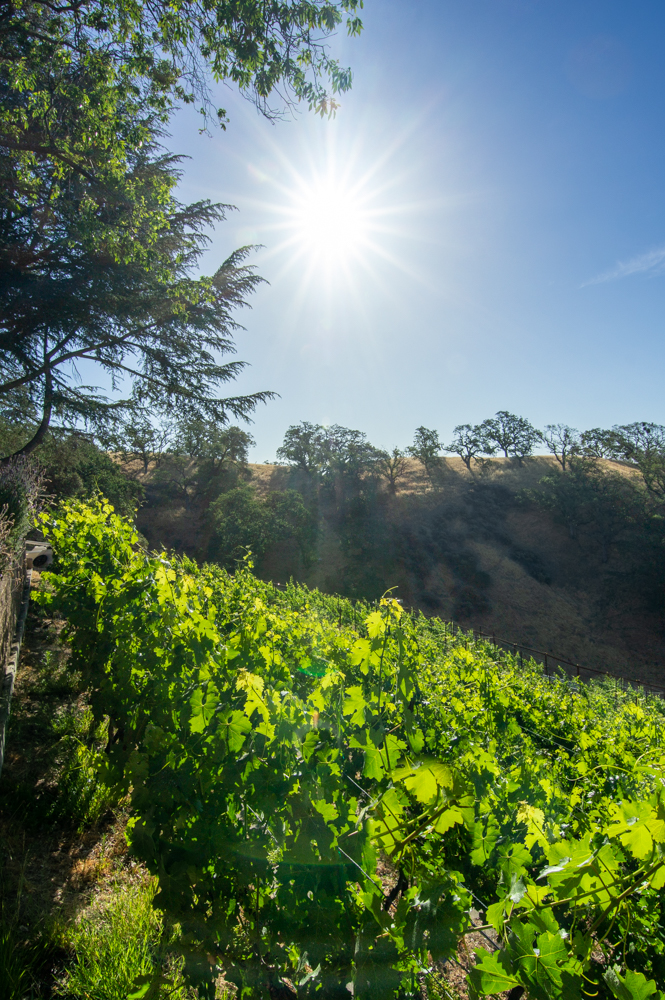

In outlining the unique characteristics of the Lamorinda viticultural area, local growers believe Lamorinda is truly unique from surrounding AVAs, including other areas within the Central Coast AVA and San Francisco Bay AVA. Characteristics of Lamorinda, however, continue to be influenced by those characteristics defining the San Francisco Bay AVA and Central Coast AVA.
Lamorinda continues to experience the moderating effects of coastal air out of the San Francisco Bay. Following data demonstrate that Brentwood, a short distance east of the Central Coast AVA and San Francisco Bay AVA has warmer temperatures than Lamorinda. Further, Lamorinda demonstrates temperatures similar to or slightly cooler than Pleasanton, which is located in the Livermore Valley AVA. Hence, Lamorinda experiences conditions consistent with the Central Coast AVA and San Francisco Bay AVA.
More specific characteristics of Lamorinda distinguish it from these larger, more generic AVAs. These characteristics include geology, soils, and reduced daytime coastal fog intrusion (but not nighttime fog).
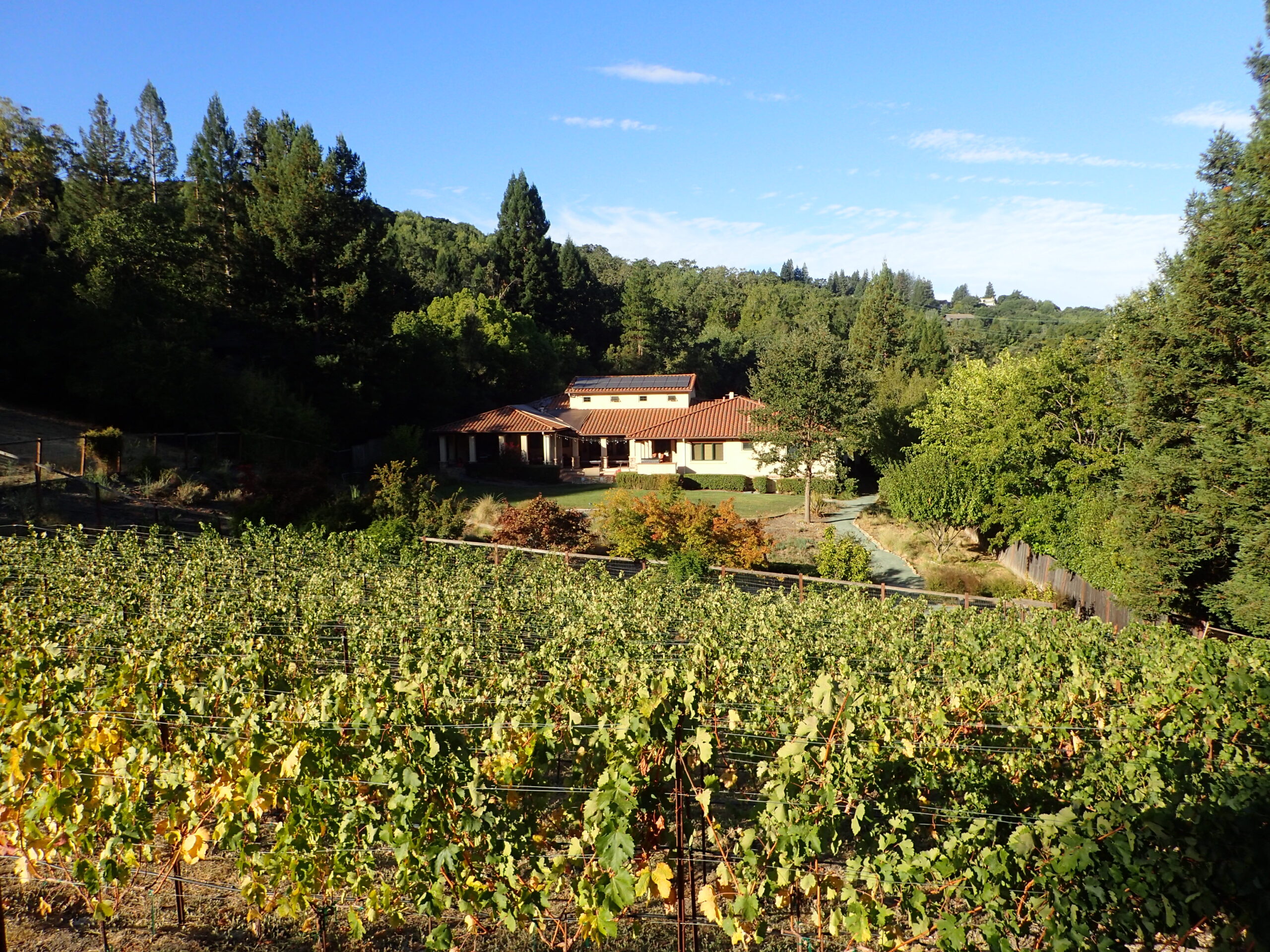
The suburban landscape of Lamorinda is also viticulturally important. The size of the vineyards combined with the hilly terrain means that all harvesting and pruning is done by hand. The small size of the vineyards and varied approaches to utilizing these microclimates leads to a greater diversity in grape varieties. Finally, the close proximity of housing to grape growing limits the use of some approaches and encourages more sustainable farming practices.
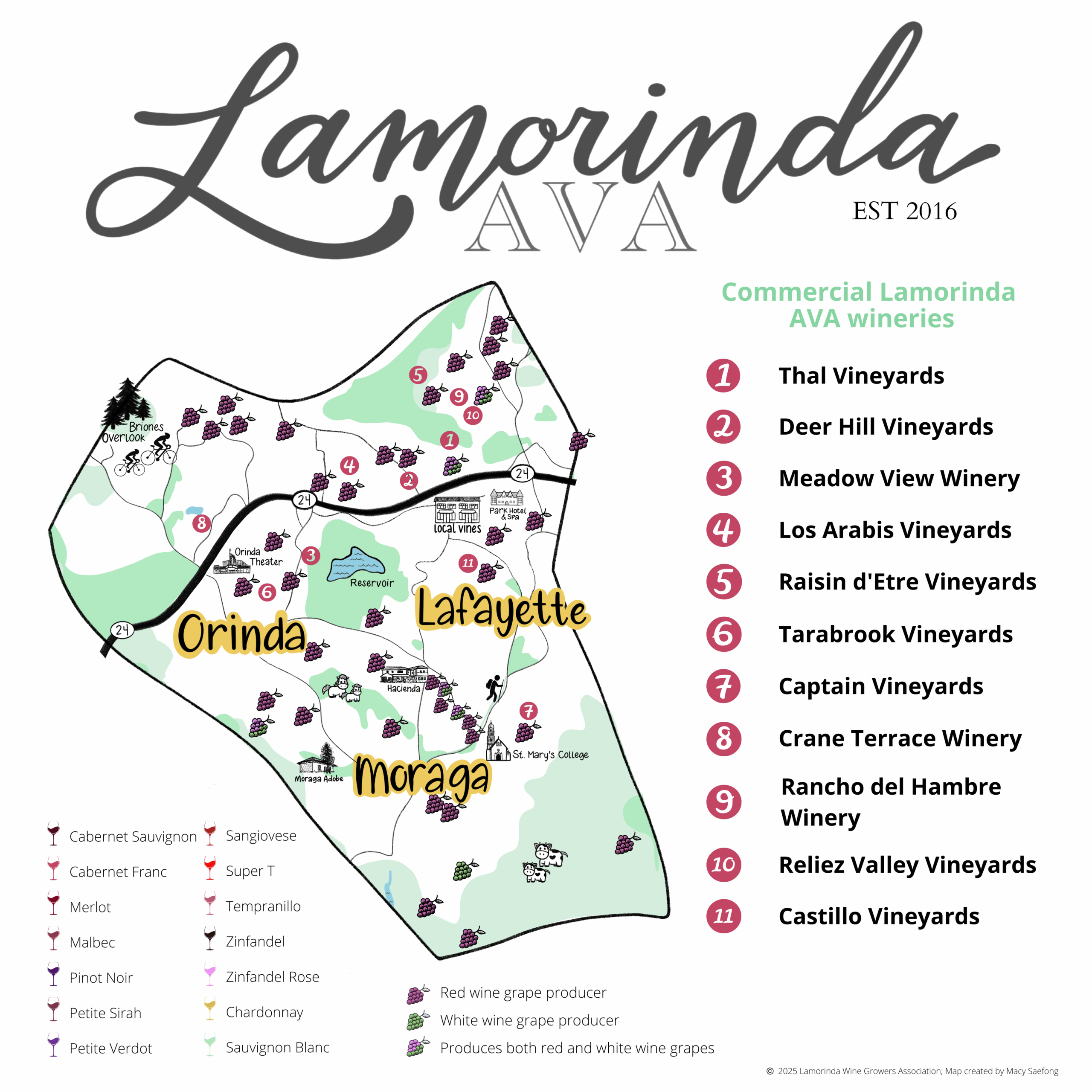
The boundaries of the Lamorinda AVA are dictated first by topography and geology, including only those areas within the steep-to-moderate slopes west of Walnut Creek and east of Oakland. Second, the area excludes the Berkeley-Oakland Hills, which are geologically different from Lamorinda. The boundaries are further refined to include those sections of the area least influenced by marine air. Finally, the boundaries are limited by steep terrain to the southeast, using Rock 2 as the southern post point, but excluding additional steep terrain to the south. As such, the boundaries were drawn to approximate the local highland areas protected from daytime coastal fog intrusions in and around the communities of Lafayette, Orinda, and Moraga. These areas are home both to the geologic and soil characteristics that distinguish the central Contra Costa highlands, but also experience less diurnal coastal fog influence.
This boundary follows points found on the following quadrangles of USGS 7.5′ Series topographic maps:
Additional information on the Lamorinda Appellation is available here:
– Lamorinda Winegrowers Association
– About Us