The rooftop bar comes to downtown Walnut Creek; the French Spot debuts artisan pastries in Concord; Local Vines opens Wednesday spotlighting Lamorinda wines; and more Dish.
By Ethan Fletcher
Updated
Courtesy of Calicraft
Calicraft Rooftop Bar Opens Friday
Calicraft Upstairs
Courtesy of Calicraft
Calicraft Brewing Co. is on track to unveil its new rooftop bar in downtown Walnut Creek this Friday. Calicraft Upstairs marks a departure for the hometown brewery, as rather than a sprawling beer garden, it is being billed as a neighborhood cocktail bar. Perched atop Va de Vi Bistro and Wine Bar overlooking Mt. Diablo Boulevard, Upstairs will offer, yes, 20 taps pouring Calicraft beers. But there will also be a signature cocktail program with a curated spirits list that includes house-made vodkas and gins concocted weekly in an onsite micro-still. Masterminded by brewmaster Thomas Vo, drinks will include a Japanese-influenced Tokyo Cosmo and a “Caprese” featuring Calicraft tomato and basil vodkas mixed with clarified tomato water and garnished with a caprese skewer (think a clear bloody Mary). The food program from culinary director Jeffrey Amber will consist of “fun small plates” that include roasted shishito peppers served with miso aioli; Foxy Nachos with kettle chips, salami, olives, peperoncini, fontina, aged balsamic, and Parmesan; and a variety of savory sourdough waffles, including a corn-dog waffle served with smoked cheddar, beer cheese, and mustard.
Calicraft Upstairs
Courtesy of Calicraft
Calicraft, which started as a contract brewery before launching its taproom and beer garden in Shadelands in Walnut Creek in 2016, is in full-on expansion mode. In addition to acquiring Heretic and its Fairfield brewing, distilling, and taproom facilities last year, Calicraft recently debuted a massive new beer garden in Davis and is in the process of launching an expansive new Shadelands HQ, complete with sweeping covered outdoor seating and a two-story facility with a bar, restaurant, and barrel-aging room that’s set to debut in April. Meanwhile, the downtown Walnut Creek project hints at Calicraft’s ambitions to be more than just a local brewery, but a bigger player in the Walnut Creek (and beyond) drinking and dining scene, says founder Blaine Landberg.
Calicraft Upstairs
Courtesy of Calicraft
“I think this is the transformative project that starts to express our original vision for Calicraft,” he says. “What I hope the vibe is and that people take away from it is that our brand is about inclusion, creativity, and pushing things forward: This is our big leap beyond just craft beer. … And this location specifically plants our Calicraft flag in the middle of Walnut Creek. Being right in the center of downtown has such meaning for us, not just as a brand but [for] what we want to bring to the community at large.”
The French Spot Debuts in Walnut Creek/Concord
The French Spot
Elliott Alexander
A couple weeks after it looked like its debut would be delayed to next year, artisan bakery and pastry shop the French Spot unexpectedly launched its first East Bay location over the weekend. Husband-wife team Vincent Attali and Maria Zapata have run their acclaimed flagship in San Francisco for several years but have wanted to expand to central Contra Costa County where they live and raise kids. Their second shop is located in Oak Grove Plaza near Trader Joe’s on the Concord-Walnut Creek border, and will offer the pair’s pastries, pies, cakes, sandwiches, and popular lineup of croissants that includes plain, ham and cheese, and ube mochi–filled Ube Mochicro varieties. The Concord location will also have more of a focus on fresh-baked breads—including baguettes, sourdoughs, and country loaves—as well as an expanded lineup of pies and custom cakes by Zapata. When we spoke earlier this year, Attali—who has worked at Las Vegas’s three-Michelin-starred Joël Robuchon and New York’s two-Michelin-starred Daniel, among other high-end restaurants and pastry shops—told us that unlike many bakeries and coffee shops, the French Spot will bake throughout the day to ensure a fresh product whenever you come in.
“You’ll be getting a croissant from an hour or so ago; we stagger our bread, so you’ll get a nice fresh loaf of bread,” he says. “All those sweet, buttery smells of a bakery—that’s all happening when you walk in there.”
Soft opening hours this week will be Thursday and Friday (8 a.m.-2 p.m.), and Saturday and Sunday (8:30 a.m.-2 p.m.). Also look out for the French Spot’s upcoming Christmas preorder menu, which will include a homemade bûche de Noël yule log.
Local Vines Opens Wednesday Highlighting Local Lamorinda Wines
It’s been a long time coming, but Local Vines debuts in Lafayette this Wednesday, fulfilling the vision of local winegrowers for a venue that highlights fruit from the Lamorinda American Viticulture wine-growing area. The tasting room, located on Mt. Diablo Boulevard near the Headlands Brewing taproom, primarily pours wines and ciders from local Lamorinda producers, of which there are a surprising number, including Crane Terrace Winery, Deer Hill Vineyards, Los Arabis Vineyards, Meadow View Winery, Mount Diablo Cider Company, Raisin d’Être Vineyards, Rancho Del Hambre Vineyard, Reliez Valley Vineyards, Stag Hill Vineyards, and Thal Vineyards. It was the owners of the latter, Larry and Esther Thal, who spearheaded the project and started work on transforming the former NAPA Auto Parts site into Local Vines more than six years ago.
Courtesy of Local Vines
The couple, who started growing grapes 30 years ago “purely accidentally” as a way to mitigate erosion on their Lafayette hills property, are emblematic of the area’s kind of homegrown, backyard winemakers organized through the Lamorinda Wine Growers Association. The tasting room, says Larry Thal, is a way to platform these wineries, whose smaller production size and inventory makes it more difficult to find placement in restaurants and grocery stores. In addition, Local Vines offers a complete 2,500-square-foot winemaking facility in the basement, with two dedicated veteran winemakers in residence, to help make the leap from quality grapes to quality wine. The hope, Thal adds, is that the venue will help facilitate more of the 100-plus grape growers in the region to become bonded wineries, thus further increasing the profile of a fledgling Lamorinda AVA with acres of potential.
“Our weather is very similar to Napa and conducive to producing consistently good wine,” says Thal. “One of my personal favorites up in Napa is Hall vineyards. We would aspire to make wines as good or better than they do at significantly less cost. We’ll never produce the quantity that they do, but that’s the high standard that we want to achieve.”
For food, Local Vines will offer standard light wine-tasting fare such as charcuterie to start. However, one half of the venue will soon be occupied by Germinate Kitchen, a commercial shared kitchen set to open in the first quarter of next year. Once it arrives, the kitchen—separated by a glass wall and run by two experienced restaurant industry vets—will be able to provide additional food for the tasting room as well as afford opportunities for private events, classes, and one-off food and wine experiences. Local Vines will be open from 2 p.m. to 7 p.m., Wednesday through Sunday, with expanded hours and an official grand opening likely in the new year.
Small Bites from Around East Bay
The San Francisco Chroniclegoes in-depth on Cafe Ohlone’s new café project inside UC Berkeley’s Lawrence Hall of Science. ‘Ammatka Cafe will offer dishes such as “rose hip jam sandwich with smoked duck and Mt. Tam Triple Cream cheese; a sundried tomato wrap with pesto made from watercress grown at the university’s indigenous community learning garden; and a brownie made from pattih, or chia, flour.”
A look inside Berkeley wine pioneer Kermit Lynch’s first new wine shop in 53 years in Larkspur’s Marin Country Mart.
Standard Fare is shuttering later this month; however, it will be replaced in west Berkeley this spring with Bolita, a Mexican pop-up known for its artisan masa made with heirloom nixtamalized corn.
Two new Asian eateries are coming to Pleasanton’s Stoneridge Shopping Center: Maruwu Seicha, a modern Japanese matcha café known for its matcha soft-serve ice cream and gelato, and Korean street food specialist Master Shin.
Berkeley’s Latin-inspired chocolatier Casa de Chocolates is expanding to Park Boulevard in Oakland, while Jungdon Katsu—whose Danville location was shuttered following a fire in October—just debuted a new brick-and-mortar restaurant in Emeryville.
Shemroon Cafe, a Persian café with Turkish coffee, Persian tea, and Middle Eastern sweets, opened in Orinda Theatre Square.
Last week we tasted through the largest collection of Lamorinda AVA wines ever assembled, as far as I know. It is a remarkably diverse growing zone, from the cool and foggy west side to the toasty eastern edge along the Walnut Creek corridor where Petite Sirah and Cab Sauv thrive.
Thank you to our panel of wine industry vets, and in just a few weeks you all will get to try the same wines at Local Vines in Lafayette!
What a difference a year can make. In the span of just a few years we have gone from the notion that all California vintages are pretty much the same to the feeling that no two are alike. The Lamorinda AVA in Contra Costa county is fortunate to sit between two competing climate forces in the cooler Berkeley and Oakland Hills/Eastern Bay area to the west with water-influenced temperatures including fog and some volcanic elements, and the warmer inland Contra Costa AVA to the east that has its own unique diurnal pattern. Through the abundant small valleys running every direction in Lamorinda, the maze of aspects and slopes helps to crystalize unique terroir pockets through nearly exclusive hillside viticulture. Cooler spots to the east can still achieve ripeness with good afternoon sunlight, cold air drainage and warmth for reds, while warmer spots to the west enjoy evening cooling and wind that can moderate daytime high temperatures. It is an AVA in which almost any cultivar can perform well in and there is still a vast amount of exploration to do.
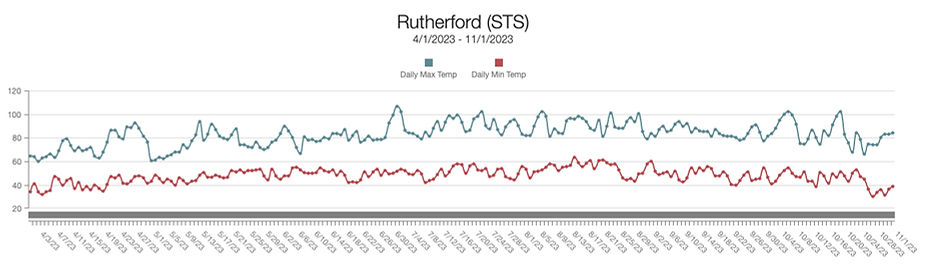
But first, some data from the last three years using Rutherford as a proxy for Lafayette. Rutherford is not as hot as Calistoga or St. Helena, and not as cool or Bay-influenced as Oakville, . The numbers for Healdsburg/Windsor as Chalk Hill or easter Russian River Valley, Rutherford, and the Lafayette Reservoir tend to be roughly comparable, so that is what is used below on the temperature charts.
Looking back, 2022 was a very strange year after the almost rainless 2021 that was awarded the driest year on record for the Northern California. The crop was also pitifully small in the North Coast. 2022 had pretty good rainfall, a moderate budbreak with unusually warm temperatures in the Spring, but into August it was running abnormally cool and almost two weeks behind, and there was a lot of work being done to choke back canopies growing vigorously from late rain and to keep mildew at bay. We were settling in for a cool vintage. Then at the start of September a record-breaking heatwave hit for a week touching 118F in many areas, followed by heavy rain (2+ inches) in many locations that put the vines back into a growth cycle, further degrading fruit quality despite a blissfully perfect ending to the season. There was much internal discussion on the destruction this level heat caused to grape chemistry, and some wineries won’t release 2022 wines. Here (I hope these temperature maps upload) is what that temperature curve looked like:
2022 Growing degree days (GDD) approx.: 3200
In 2023 things changed again with one of the coolest and latest vintages on record, bolstered by heavy rain in the winter that pushed crop load upward. Disease pressure was extreme with mildew and botrytis a constant threat without temperatures above 85F to suppress it, and mildewed grapes were refused all over Sonoma County, and high VA fermentations were a problem everywhere. The Lamorinda AVA fared well since hillside vineyards are naturally limited in their water availability, and the leaner canopies lowered the disease threat along with the AVA’s abundance of grapes with small clusters and lack of heavily-cropped white grapes. All those valleys also promote airflow which is always helpful with mildew pressure, and though temperatures were low there was a good amount of hangtime, allowing ripeness to build slowly with moderate sugars, and good weather through October was just what was needed.
2023 Growing degree days (GDD) approx. 2700
But 2024 was a different story all together yet again, and very unusual. Much like the scorching 2020 vintage that had similar heat which was evidenced by fires throughout the state, the 2023/24 winter had heavy rainfall, well above normal in many areas with fully loaded soils. It came out of the gate hot and fast, and as the grapes approached veraison most growers in Lamorinda were already watering regularly and we were seeing lots 100F days. Some areas in Lamorinda touched 100 degrees over 40 times, and though one heat wave has become the new normal, two in late season, especially back-to-back AND in October is extremely unusual. However, there is also a subtle fortunate feature that has not been mentioned in vintage reports thus far – the evening temperatures were actually a little lower than normal relative to the daytime heat, creating a moderating effect that helped the vines recover, especially in Lamorinda.
2024 Growing degree days (GDD) approx. 3700
Viticulture: Overall Lamorinda grapes did very well for a challenging vintage. Canopies were mostly filled out thanks to good rainfall, though this can be limited by steep hillsides, and good rainfall helps continue root growth in the spring leading to stronger vines. The grapes in cooler areas such as Moraga and Orinda had it a little easier, but even hot vineyards looked good, though the constant heat stress made for a state-wide light crop. The double heat whammy in late September and October was stressful, and during the second spike in October some saw their fruit increase one degree brix per day, but despite some acid softening and low nitrogen, grapes that had been take care of made great wine with ripe fruit and good structure. When you have two heat spikes, there is only so much you can do.
Vineyards that did not fare well generally had either mildew problems, irrigation issues, or improper netting. Despite the heat (mildew does not grow above 85F) we still saw quite a few vineyards that had fruit damage due to early season mildew. This was a very wet spring which is always challenging, possible issues due to shading and proximity to trees, insufficient spray application (which is very hard to do by hand in all of these tractor-less steep vineyards) or not rotating chemistries, like using sulfur, then an oil, and then biologicals or strobilurins. Mildew creates microscopic holes in berries, which creates all sorts of problems, and it can be seen as grey or black specks on the fruit and in the clusters on stems, or mold-like spots on leaves. It has a musty, white pepper smell as well. It is always present and grows between 70-85F and without full sunlight, we just keep it at bay with most sprays. Some growers experienced heavy insect damage, but this was likely due to improper mildew control early in the season or predation. Some mildew in May easily leads to perforated sugar-filled berries in August that insects can smell, and that grape sugar in broken berries or on stems that have had the grapes pulled off send out a feeding beacon to all sugar-loving insects and even birds, not to mention sugar that ferments and then turns into vinegar and all sorts of microbial mayhem. Sound fruit should not experience any insect issues if the birds are kept out, but once berries are broken, it will all go downhill rapidly.
If one thing was clear for late season grape growers (Cabernet Sauvignon and in cooler pockets) it is that once you are behind on irrigation, it is impossible to “catch up” again. Drip irrigation can help keep vines stay a little more comfortable during a heat event, but it is impossible to apply enough water to negate the heat. A second heat spike only compounds this, especially with vines are at the end of their cycle when they just want to sleep. On this topic growers are advised to always watch the 10-day agricultural forecast, make sure that vineyard managers have checked all irrigation lines and that all controls are working properly, and visually check and confirm the system is functioning whenever possible. Coyotes love to chew through drip lines, hose ends can blow off, sun exposure can crack risers, and all sorts of problems can appear from nowhere. Hillside drip irrigation does not allow for much soil penetration either, so while your friends in Rutherford might get away with 4 gallons per week per vine in the last month before picking, you on a hillside will need far more, possibly 15 gallons per week per vine leading up to harvest. Remember that we are largely on sandstone and clay here, which has limited water-holding capacity depending on the amount of clay in your particular vineyard, and organic matter is hard to build in these hills, so holding onto the drip is a challenge. Former seabed ironically doesn’t hold much water, especially on steep hillsides, and I have noticed a few vineyards with the wrong rootstocks for hillsides (101-14 in particular) which will require even more water. Planting vines close together (most plantings are very close in Lamorinda) requires even more water to boot compared to wider distances between vines. The thinking on tight vine planting has changed a lot in the last 15 years.
Lamorinda is also unique in the necessity of bird netting. With so much beautiful woodland surrounding the vineyards it is also a paradise to birds, skunks, foxes, ground squirrels, deer, turkeys, and every type of animal that also loves sugar-rich grapes. Tightly secured netting is a must, but before the netting goes up at veraison, the canopies must have all the final work and tuning done first, meaning that final shoot thinning and any fruit thinning (not too much of a problem on hillsides) all needs to be done before the nets go on during or immediately after veraison. Walking the vineyard to check irrigation lines and check netting closures are always a good (and relaxing) idea.
There also a predominance of spur pruning in the area that makes for an interesting topic. Some cultivars like Syrah and Sauvignon Blanc are usually cane pruned, and in Bordeaux most Cabernets and Merlot are cane pruned as well in their wetter climates, but I have yet to see a single cane-pruned vine in Lamorinda. If you suspect trunk diseases like eutypa, or any sort of disease-related decline in your cordon arms, it may be time to gently go back to creating a new arm from a cane. Though many diseases generally come from neighboring vineyards which is not a problem in Lamorinda, the woodland also harbors fungal pathogens. The last 10 years a wealth of information has been published regarding a new understanding of vine pruning that prioritizes protecting the vines and building them for resilience that is worth investigating for vineyard owners who want to get their hands dirty. Wetter/cooler spots like in Orinda might want to consider the viability of cane pruning if disease pressure is a constant problem. You can even go half-and-half to experiment.
Winemaking: Unlike the record heat spike in 2022 that destroyed color (anthocyanin) in grapes on the vine by cooking them in place before they were even 21 brix, it did not get hot enough for that to happen in Lamorinda. Vines can tolerate quite a few days around 100 degrees if they have had some acclimation, and since Lamorinda is a solid zone 3 in general though there are exceptions on either side, vines will usually not be shocked by heat. Grape chemistries proved to be as unique as each person’s vineyard this year, but in general acids were as expected with some low-ish from the heat but some just right, tannin ripeness was great and nothing was noticeably off. There were some late-season picks that had perfect numbers, and a couple early ones that needed a little work, so it really comes down to the owner keeping a vigilant eye on everything and a communicative crew with an expert on board to react in a timely manner to the growing season, plus the general health of the vines.
The largest challenge for us at the winery in this hot year was receiving hot grapes. If the grapes arrive over 75 degrees we might have a problem. Fermentations want to start around 60-65 degrees for red wines and hopefully cooler, and colder for whites. Please do not pick grapes after 9am on a hot day. That fruit needs to arrive at the winery cold, the colder the better. I am used to meeting the pickers to start at 4 am and using headlamps. With bird netting make that 3 am. With hillside vineyards where every picking tub must be carried up and down a hill by hand, make that 2 am. Yeasts and bacteria are always present and they grow exponentially with heat, so keep those grapes as cool as possible, and keep them out of the sun once picked!
One other anomaly was that a few vineyards with great looking fruit had peculiar sulfur issues before fermentation had even started, which may have been from molecular sulfur remaining on the grapes. If you suspect that your vineyard team is only using sulfur for mildew suppression or are still using sulfur after the berries have sized up or into veraison, you should have them rotate to something else from the list above. Residual sulfur dust can be particularly terrible in fermentations, and micronized sulfur can be a problem as well. If used as a later-season spray in tight-bunch cultivars like Petite Sirah, Grenache, Petit Verdot, Sauvignon Blanc, and sometimes Pinot Noir, you run the risk that as the berries expand to full size the sulfur can become trapped between the berries, leading to problems down the road.
With the heat it is inevitable that grape nitrogen may be a little low, and some shrivel is inevitable with extreme heat. There were a couple vineyards that came in with challenging numbers in early September. They already had high sugars, high malic acid, and high potassium and pH, meaning three winery challenges at once. These are probably traceable back to lack of water leading to vine shut down early on, and possible overexposure to sun. If you have had a few years with some sunburn or challenging numbers at pick time, let’s take a look and see what we can do.
The wine business in general: For the second year in a row wine consumption has fallen by over 10%. The Central Valley continues to remove vineyards, grape contracts everywhere are broken, and wine tourism continues to decline. I had colleagues picking up Napa fruit that was usually $8,000+ per ton for $1,000 in October. Here in the Lamorinda area we are somewhat insulated from the urban anti-alcohol movement among young consumers, and many feel that we may have reached to bottom of the decline, which would be great. Though the WHO is not going to change their anti-alcohol stance, regime change in Washington is throwing all the cards into the air once again with a mix of tariffs, possible deportations, and FDA revisions (your food pyramid and dietary guidelines including alcohol are all on the table in 2025) that will all affect the wine business deeply on way or another.
All in all, Lamorinda had a great vintage despite quite a few challenges this year. Back-to-back heat spikes is no joke, and it is possible that pest pressure was extra high this year as the ebb and flow of wildlife and insect interaction seems to fluctuate with each vintage these days. Be sure to give yourself a big pat on the back. If there are things you would like to improve upon, please discuss things with your vineyard manager during the winter, well before the vines start growing. Winter is the time to plan any changes and discuss what worked and what didn’t. I would also personally love to visit everyone’s vineyard in person and I’m happy to offer any thoughts or help in any way I can. Understanding the vineyards helps make better wine, which will only help the AVA as it continues to move forward.
Pietro Buttitta Thal Vineyards/Local Vines
Prima Materia Vineyard & Winery info@prima-materia.com
Retrieved September 18, 2025
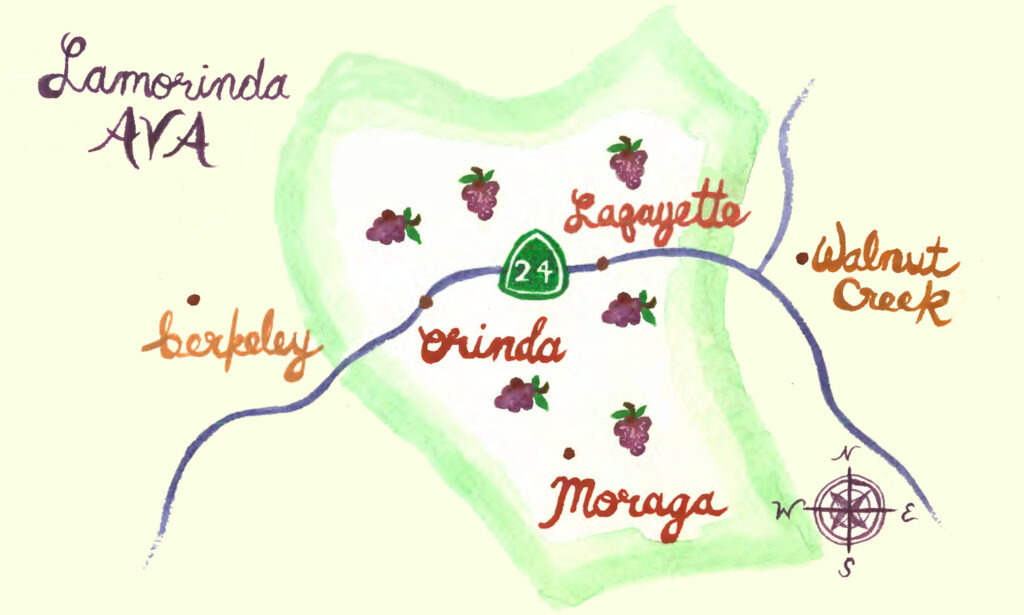
Lamorinda is an American Viticultural Area (AVA) in the San Francisco Bay Area located due east of the Berkeley Hills in Contra Costa County encompassing the region around the cities of Lafayette, Moraga and Orinda. The name Lamorinda is a portmanteau from the names of the three locales defining the region: Lafayette, Moraga, and Orinda. The AVA is a sub-region within the existing San Francisco Bay AVA and the larger, multi-county Central Coast AVA stretching approximately 30,000 acres (47 sq mi) with 46 commercially-producing vineyards that cover approximately 139 acres (56 ha), and six bonded wineries with plans for three more.[2][4] The USDA plant hardiness zone for the AVA is 9b.[6] The AVA was proposed as the growers in the area found the wider San Francisco Bay and Central Coast AVA titles too generic and not indicative of its terroir. The area was officially established on February 23, 2016, by the Alcohol and Tobacco Tax and Trade Bureau (TTB), Treasury after reviewing the petition from Patrick L. Shabram, on behalf of the Lamorinda Wine Growers Association, proposing the establishment of the “Lamorinda” viticultural area.[1][7]
Commercial grape and wine production in the Lamorinda area dates back over 150 years. A directory by Ernest P. Peninou, a well-known wine historian, and Sidney S. Greenleaf shows local growers John Grinnell, Daniel Hunsacker, Isaac Hunsaker, and William B. Rodgers collectively had 623 US gal (2,358.3 L) of wine on hand during an 1860 census.[8] All growers within this census are listed as “Lafayette and Alamo.” Although the current city of Alamo lies outside the Lamorinda viticultural area, Lafayette clearly had an early association with viticulture. Beginning in 1907, Serafino Rossi grew wine grapes commercially at a site currently occupied by Reliez Valley Vineyards in Lafayette, according to research conducted in the archives of the Lafayette Historical Society. Based on additional research conducted in the archives of the Moraga Historical Society and Orinda Historical Society, wine grapes were one of many crops grown by early settlers. The Trelut brothers, who settled in Moraga in 1880, planted grapes and made wine on a relatively large scale. By 1897, Theodore Wagner was commercially growing grapes in the Orinda area. While some grapes were made into wine locally, most were shipped out of the area, with much of the production apparently sold to immigrant Italians in the North Beach area of San Francisco. None of these early vineyards survive today, although, as mentioned above, there is currently a vineyard and winery on the site of the original Rossi vineyard. The agricultural focus of the area was gradually replaced by suburban housing development, but a renaissance of small-scale wine production began in the late 1970’s. These plantings started with John Alegria, who planted one thousand vines in Moraga in 1978. The number of plantings has accelerated in recent years and led to the founding of the Lamorinda Wine Growers Association in 2005. The first bonded winery, Parkmon Vineyards, was also established in 2005 in Moraga.[2]
Terroir
The distinguishing features of the Lamorinda area are its topography, geology, soils, and climate. The terrain is composed of moderate-to-steep hills with narrow valleys. The steep hillsides prevent the use of machinery for vineyard work instead requiring the work to be done manually. The terrain contrasts with the steeper, more rugged terrain to the south and west and the lower, flatter plains to the north and east. Additionally, Lamorinda AVA is characterized by a distinct suburban land use pattern which tends to provide property owners with enough room to plant vineyards large enough for commercial viticulture. This contrasts with the more urban and densely populated areas to the east and west. The dominant geological formation is the Orinda Formation, while the Briones and Mulholland Formations are also present. These underlying geological formations affect viticulture due to their role in forming the soils of the region. Other geographic formations dominate the surrounding areas. The AVA is suitable for both cool and warm-climate varietals because the hilly terrain results in disparate levels of sunlight at different elevations. The Berkeley Hills affect the local climate by their elevation. The oceanic marine layer, which develops during the summer, bringing fog and low clouds with it, is usually less than 2,000 feet (610 m) deep and thus is blocked by the range. This produces a “fog shadow” effect to the east, which is warmer than areas west of the hills. The westerly wind that carries the marine layer through the Golden Gate typically splits its flow as it hits the Berkeley Hills producing a southerly wind from Berkeley northward and a northerly wind in the direction of Oakland. In winter during spells of tule fog inland, a reverse situation occurs, with the fog usually confined to areas east of the hills. Rainfall is also affected by the higher elevations when westerly winds from the Pacific are perpendicular to the hills during a storm and forced to rise, cooling and condensing additional moisture, increasing the precipitation on the western slopes but leaving areas east of the hills drier.[1]
Community Industry
The wine industry from the Lamorinda region, including vineyard owners, winemakers, and retail wine shop proprietors supported the establishment of the AVA due to the unique microclimates, soils, and geology of the region. It is far from being a commercial winegrowing area, instead hosting a number of small home wineries making just enough wine to satisfy the local demand. There is a strong sense of community identity and commitment in Lamorinda to help consumers identify and buy its local wines.[7] The Lamorinda Wine Growers Association (LWGA) is dedicated to providing education and support resulting in the production of high-quality grapes and wine in an environmentally friendly and socially responsible fashion; promoting the Lamorinda community and its status as a winegrowing region, enhancing the marketability of Lamorinda-grown grapes and Lamorinda-made wine; and cultivate a strong relationship with the local community.[9]
Crane Terrace vines planted on the cave exterior Photos Vera Kochan
Nestled on a private estate in Orinda’s Sleepy Hollow neighborhood, Crane Terrace Winery, a 2-year Lamorinda Wine Growers Association member, had once produced their wines exclusively for personal enjoyment or sharing with friends. Having gone through the rigors of becoming bonded this past July, the winery is now entitled to sell to the public.
Crane Terrace’s General Manager Leanne Pilot was more than knowledgeable about every aspect of the business and its history since starting with the winery in 2016 as a property manager. Coming from Chicago and working in the IT industry, Pilot’s move to California exposed her to a lot of great wines, and a new passion was born.
Initially, the winery’s approximately 4,500 grape vines were planted in 2004, along hillsides that could easily resemble Italy’s Tuscany region. This extensive number of vines makes Crane Terrace the largest winery in the Lamorinda American Viticultural Area (AVA). The entire property encompasses 8 acres, but only 3-4 acres are devoted to the vines which grow along steep slopes producing Syrah, Grenache, Chardonnay, and Roussanne. Crane Terrace’s first vintage was bottled in 2006, and in 2010 a lengthy cave was dug through one of the hillsides and now serves as a cool storage area furnished with chandeliers, soft lights, a polished banquet-style table and chairs for either tastings or meetings.
“The wines kept getting better and better,” said Pilot. “We needed to go beyond just making wine for friends and family.”
Crane Terrace’s 2017 Chardonnay back label states, “Grown in the East Bay hills on our family’s private estate vineyard, our Chardonnay grapes are biodynamically farmed and tended by hand using ‘old world’ care and techniques that produce low yielding high quality fruit. This wine was produced in temperature controlled stainless steel and aged in the finest French cooperage producing a wine that’s rich in character.”
“We are completely hand-farmed and don’t use any pesticides or toxins,” explained Pilot, adding that they use a vineyard management company that comes to prune the vines and do the picking at harvest-time.
Crane Terrace bottles, on average, 50 cases of Grenache, 50 cases of Chardonnay and 300 cases of Syrah. “We’ve blended the Roussanne with the Grenache in the past, or our winemaker will use it for some other purpose of his own,” Pilot explained.
The winemaker’s tasting notes for their 2021 Chardonnay are: “Nose – Very ‘Chablis-like’ with notes of citrus and hints of vanilla. On the palate, this wine is structured with solid acid, lemon, mineral, and green apple.” The recommended pairing is to serve it with seafood.
With their 2021 Grenache: “Nose — Restrained notes of strawberry, flint, and cedar. On the palate this wine is suitably structured with solid acidity, meaty with notes of strawberry, and violets, and of light body.” The recommended pairing is savory, grilled meats with smoky barbecue sauces and grilled vegetables such as zucchini or eggplant.
The 2021 Syrah: “Nose – filled with leather, tobacco, and hints of olallieberry. On the palate, you’ll find notes of raspberry, blackberry, black pepper, with structured acidity and medium to light body for a Syrah.” Suggested pairing with duck, grilled chicken and an assortment of hard artisanal cheeses.
Crane Terraces poured at Moraga’s 2022 Pear and Wine Festival and more recently at last month’s Lafayette Art and Wine Festival.
Pilot is on the cusp of completing a new website. In the meantime, anyone wishing to contact the winery can email Pilot at Leannepilot@craneterracewinery. Local deliveries will be available.
Vines planted along the hillside at Crane Terrace Winery Photos Vera Kochan
Inside Crane Terrace Winery cave Photos Vera Kochan
Shared from https://www.writtenpalette.com/discover-lamorinda-ava/
Many people are unaware that there is an AVA on the East Bay of San Francisco. The Lamorinda AVA, a hidden gem, is part of the Central Coast and San Francisco Bay AVAs. Located in Contra Costa County, the Lamorinda AVA encompasses the cities of Lafayette, Moraga, and Orinda. Let’s discover more about this little-known appellation and the micro-boutique wineries in this region.
Established as an AVA in 2016, Lamorinda, whose name combines the three cities that lie within the AVA. The Lamorinda AVA’s 30,000 acres consist of 139 acres planted with vineyards. These are suburban vineyards on residential lots. Most vineyards are terraced with thin clay-rich and sandy soils on hillside terrain. Because of the steep hills, vineyard maintenance and harvest are accomplished manually.
Lamorinda AVA map. Photo Couresy of Lamorinda Wine Growers Association
The climate is maritime. The Berkley Hills and the oceanic breeze and fog coming in from San Francisco Bay affect the area. With the variation of temperature throughout the AVA, warm and cool climate varieties grow depending on the location. The varietals grown include Chardonnay, Chenin Blanc, and Sauvignon Blanc in the whites and Cabernet Franc, Cabernet Sauvignon, Merlot, Petite Sirah, Petit Verdot, Pinot Noir, Sangiovese, and Syrah in the reds.
The Lamorinda Wine Growers Association consists of 80 members and six bonded wineries. In addition to the bonded wineries, there are many home winemakers. I had the privilege of sampling the wines of five of the bonded wineries.
Table of Contents
Deer Hill Vineyards
Bill Scanlin, owner and winemaker of Deer Hill Vineyards, planted his vineyards in 1998 with mostly Cabernet Sauvignon and a field blend of Merlot, Cabernet, and Malbec. The winery was bonded in 2010. In addition to his own wines, he produces wine for other local vineyard owners.
Bill Scanlin, Deer Hill Vineyards Tasting Room
When Bill purchased his home, he was unsure about what to do with his hilly acreage. Shortly after, a neighbor suggested he grow grapes, which Bill did with three-quarters of an acre. His first vintage, a Cabernet Sauvignon, occurred three years later in 2001. Bill started as a home winemaker, but as his passion grew, he not only got bonded but he created an Italian grotto for tasting in what some might call his basement, an extension of his garage. A local muralist created murals that bring the outdoors inside. You walk in and go, wow, as it makes for an extraordinary experience. The ambiance adds to the lure of Bill’s wines.
Deer Hill Vineyards
Bill started making Sangiovese in 2016. Since then, he has won numerous awards for his Sangiovese each year. His Sangiovese won Best in Class at the San Francisco Chronicle wine competition in 2017. Imagine his joy of producing a wine that can compete with the big guys of Napa.
Bill’s philosophy is to use low intervention, which comes through in his wines. He sources grapes for his Chardonnay from UC Davis and a vineyard in Walnut Creek. The Chardonnay ages for one year in oak.
My favorites were the Sangiovese, with its rustic qualities of red fruit, and the Cabernet Sauvignon, showcasing dark fruit and lower tannins. The Sangiovese and the Cabernet Sauvignon were drier on the palate and aged for two years in oak.
Deer Hill Vineyards Cabernet Sauvignon and Sangiovese
Los Arabis Vineyards
Named after the Arabian horses that ran around the hillside where winemaker/owner Jim and Leslie Ward live, the winery focuses on Pinot Noir. Leslie planted her vineyard in 1999 with 1500 Pinot Noir vines. In 2002, Los Arabis Vineyards produced its first vintage. The idea to plant vines came as they worried about the maintenance and potential fire hazard of their 3-acre hillside during the summer months. The Wards chose Pinot Noir because Lafayette’s climate features a pronounced diurnal shift from day to night, which lends itself to growing Pinot Noir.
Jim and Leslie Ward at Los Arabis Wine Cave. Photo Courtesy of Los Arabis
The property, situated in the Happy Valley portion of Lafayette, features a wine cave with a private tasting room, and the hillside terraced vines enjoy a southwestern exposure. Winemaker Allison Schneider oversees production. The Pinot Noir ages for 18 months in both French and American oak. I found a medium-bodied wine with lovely aromatics and cherry flavors.
Los Arabis Vineyards Pinot Noir
Meadow View Winery
Winemaking started as a hobby for Bill English, a chemical engineer, and later became his 2nd career. He first began making wine in 1976. With some hiatuses in between, Meadow View Winery was licensed in 2014. He has steadily produced wine for about thirteen years. Until that time, he called himself an amateur.
Today, Meadow View Winery aims to create the best possible wine from fruit sourced from the Lamorinda AVA. Bill strives for balance, which means good body without excessive alcohol. The acidity is refreshing.
Bill primarily utilizes fruit from three vineyards whose temperature profiles are similar to those of Sonoma and Napa. The first vineyard, Isabelle’s Vineyard, just outside Moraga, Bill sources Cabernet Sauvignon, Cabernet Franc, and Sangiovese. This vineyard has a cool temperature profile. Mary Leigh’s Vineyard is situated in Moraga, where they source Chardonnay, Sangiovese, and Syrah. The third vineyard, Jon’s Vineyard, located next to Mary’s Bill, utilizes their Sangiovese, Merlot, and Chardonnay.
Bill English with Doug Spear and Isabelle Ord from Isabelle’s Vineyard. Photo Courtesy of Meadow View Winery
Bill picks the grapes early from all three vineyards, avoiding excessive alcohol. Fermentation and aging occur separately.
The wines are far from amateur. Bill makes Chardonnay, Cabernet Sauvignon, Cabernet Franc, and a wine called Super T, his version of a Super Tuscan. I sampled the Super T and the Cabernet Sauvignon. Both were excellent.
Meadow View Super T 2019: Mainly combining Sangiovese with small portions of Cabernet Sauvignon and Cabernet Franc, the wine utilizes grapes from all three vineyards Meadow View sources fruit. The wine ages 20 months in French oak and represents Meadow View’s most popular wine, and I can see why. The wine displays a nice balance and integration with subtle fruit nuances.
Meadow View Winery Cabernet Sauvignon
Meadow View Cabernet Sauvignon 2018: This Cabernet combines Cabernet Sauvignon primarily with Cabernet Franc. I found depth of character that exhibits a savory, herbaceous wine with dark fruit.
Meadow View Winery Super T
Raisin d’Être Vineyards
Daniel Howsepian, proprietor of Raisin d’Être Vineyards, as a child, would visit his French relatives in France during the summer. While in Burgundy, he would spend time with his uncle JoJo, who was the Cellar Master of “Dufouleur Père et Fils” in Nuits-Saint-Georges. His uncle and his family inspired Daniel to dream of one day making wine and eventually owning his winery. Daniel’s dream also inspired his son, Julien, the winemaker at Kosta Brown.
Daniel’s career path led him into building development, primarily focusing on residential projects. Of course, that experience played a role in constructing his winery. The winery is built into a hill and constructed around the concept of gravity flow.
Daniel Howepain in the Vineyard. Photo Courtesy Raisin d’Être
The name Raisin d’Être is Daniel’s take on the French expression Raison d’Être, which means ‘reason for being.’ I think it describes Daniel’s love of growing grapes and making wine, as well as his reason for being.
The vineyards, located in Lafayette, were planted in 2013 with Cabernet Sauvignon and a small portion of Merlot. Daniel sources his Petite Sirah from a neighbor and his Petit Verdot from someone in Moraga.
Daniel perfects his wines by using organic methods to nurture the soil, hand-pruning, harvesting, and in the winery, employing minimal intervention.
Raisin d’Être Cabernet Sauvignon 2018: The wine blends Cabernet Sauvignon with a small percentage of Petite Sirah. While the wine ages for two years in both new and neutral oak before bottling, I found a big, brooding Cabernet with dark fruit.
Raisin d’Être Petite Sirah 2018: The wine blends a small percentage of Cabernet Sauvignon with the Petite Sirah and ages for two years. I found Petite Sirah exhibits dark black fruit flavors and reveals itself as drier than other versions of this variety.
Raisin d’Être Cabernet Sauvignon and Petite Sirah
Thal Vineyards
Thal Vineyards was established in 2010 by Larry and Esther Thal. With over 2,000 vines, principally Cabernet Sauvignon, Merlot, and Sauvignon Blanc, Thal harvested its first vintage in 2012. Like others in the area, they planted vines to provide a drought-tolerant and fire-resistant solution for their hillside property. Bill English is their winemaker.
Thal Vineyards Sauvignon Blanc 2020: This Sauvignon Blanc is crafted in a style similar to Chardonnay. The wine barrel ferments and ages for ten months in French oak. The barrel aging gives the wine its creamier texture. I found floral aromas followed by citrus, mainly lemon, accented by stone and tropical fruits on the palate.
Thal Vineyards Sauvignon Blanc
Lamorinda AVA Wineries and Winemakers
Unique to the Lamorinda AVA, besides all the vineyards situated on hillside slopes, is the community’s camaraderie and the love and passion exuded by these winery owners and winemakers. The community wants everyone to succeed as they work together, encouraging and supporting each other. This cooperation will come full circle when their joint tasting room, Local Vines, opens in 2023.
The quality of the wine and the price points make this an area to keep on your radar. If you visit the East Bay, include the Lamorinda AVA in your wine tasting itinerary.
I would like to thank Visit Concord for introducing me to this fabulous AVA.
Note: As is common in the wine industry, this writer received a hosted winetasting and samples. While it has not influenced this review, the writer believes in full disclosure.
San Francisco is a lively city full of quirky shops, international bars and restaurants, and massive museums and attractions like Alcatraz and the Ghirardelli Chocolate Factory.
But it takes less than an hour for the urban oasis to be replaced by vineyards and tasting rooms. When you think of California wine country or San Francisco wine country, you probably think of Napa and Sonoma — but if you’ve already been there, don’t despair.
California has more than 4,000 wineries and 143 American viticultural areas, or AVAs — designations for wineries in certain geographic areas that meet national standards, like the “Napa AVA.” For reference, there are only 261 AVAs in the entire US. That means more than half of all the notable wine-growing regions in the country are in California, which should give you some hint of how easy it is to find somewhere new to wet your whistle.
If you’re looking for a change of pace from Napa or Sonoma, check out these six affordable, under-the-radar, and downright tasty San Francisco wine country stops for a weekend or day trip from the city.
You can have AVAs within larger AVAs, which is the case with the Lamorinda AVA — it’s a smaller wine-growing region within the larger San Francisco AVA. And yes, that does mean it’s close to the city. The Lamorinda AVA true San Francisco wine country, since you can visit its top wineries without needing a car (like a true SF local has a car, anyway).
From SF, take the BART to Lafayette; it’s about a 30-minute ride. While it doesn’t have the dozens upon dozens of wineries of a larger AVA, it has plenty to fill a day trip. In Lafayette, you’ll find Captain Vineyards, Thal Vineyards, and Deer Hill Vineyards. If you’re willing to take a short taxi or rideshare ride from Lafayette, you’ll find more another dozen or so wineries around Walnut Creek, Concord, and Avon, many of which are open for tastings.
There’s no denying that the Napa AVA is huge — there are more than 400 wineries in Napa. But it’s not the only destination with enough vineyards to fill a dozen vacations. In Monterey, you’ll find more than 175 wineries and tasting rooms, making it one of the best San Francisco wine country options for a long weekend away from the city.
The Monterey Wine Grower’s Association already did the trip-planning work for guests with a perfect long weekend wine-tasting itinerary available online. The region is particularly notable for its chardonnays, which tend to have hints of orchard fruits like apples and pears, but aren’t overly sweet or fruity. But with the sheer number of wineries available, you’re bound to find something to love even if your palate gravitates towards rich cab francs.
Like in Napa, wine is a major industry around Monterey, and you’ll find operators running wine and cycle tours, wine and driving tours, and hotels with their own vineyards. But another great reason to head to Monterey’s wine county is that you don’t even have to set foot on a winery. If you’d rather get straight to the tasting, you can drop into one of 19 tasting rooms in Carmel-by-the-Sea, six in Monterey, or another 26 in Carmel County. And yes, they’re all conveniently mapped for you, so you won’t get lost even if you do go a bit hard on those chardonnays.
Getting to Napa requires a short drive to the east, and while it should take no more than an hour, traffic can sometimes make the trip drag on to nearly double that time. So instead, consider heading north, across the Golden Gate Bridge and up to Marin County, just across the water. There are about 17 wineries within a quick drive, and as you may expect if you’re familiar with the nearby (and famous) Anderson Valley, pinot noirs are prevalent in Marin.
Visiting San Francisco’s wine country to the north is a fairly easy drive. Once you cross the bridge, you’ll hit Sausalito, where you’ll find the Real Napa Tasting Room and JR. Story Winery. Stay on the 101 and you’ll h it wineries like Dancing Crow Vineyards and Backstage Winery. You’ll find Thackrey and Co. winery closer to Point Reyes, and you’ll have half a dozen more options closer to Petaluma, though at that point, you’ve moved into Sonoma County.
Marin makes a stunning and surprisingly small-town-feeling day trip from the Bay Area, especially if you add in an outdoorsy activity like a hike through the Point Reyes Elk Sanctuary.
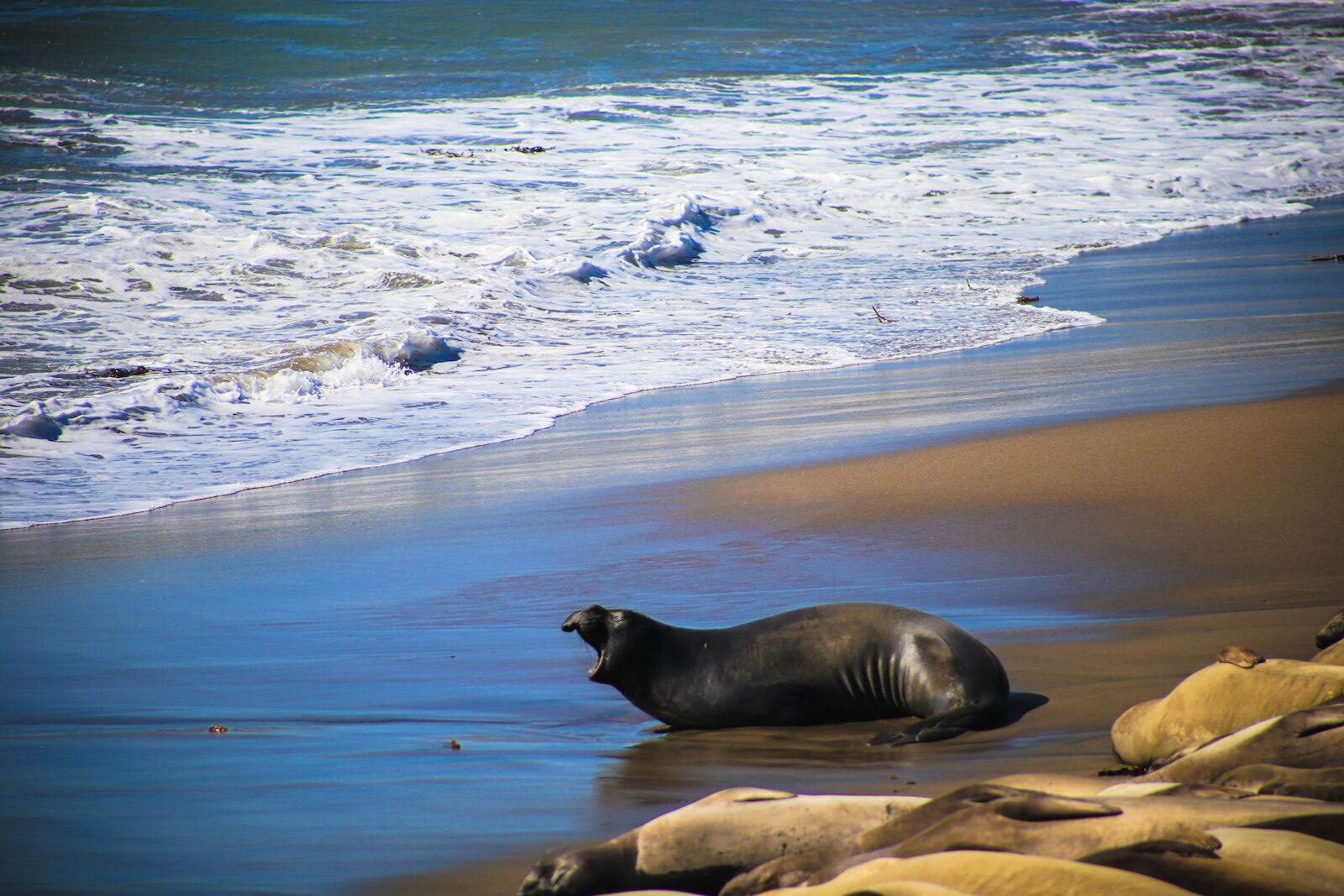
SLO — technically called San Luis Obispo but pronounced “slow” — is a quirky surf town surrounded by quirky attractions. It’s the best San Francisco wine country weekend trip if you want to pair wine tasting with unique roadside stops like an elephant seal breeding ground or the over-the-top Hearst Castle. It’s also home to the Madonna Inn, with ridiculously thematic hotel rooms designed after cavemen, haciendas, and the Wild West.
For a truly unique wine weekend, add on a new winery activity like ziplining through the fields at Ancient Peaks Winery or cycling through the Edna Valley. And don’t worry: bike tours come with a support van in case you get too tired (or too tipsy) to keep biking. Most of SLO’s wineries are around the Edna Valley, though there are several tasting rooms in San Luis Obispo proper and another handful near San Simeon. The latter is a great place to stop after a tour of Hearst Castle, which also has its own winery. It’s inland, but the tasting room is just across the street from Hearst Castle along Highway 1.
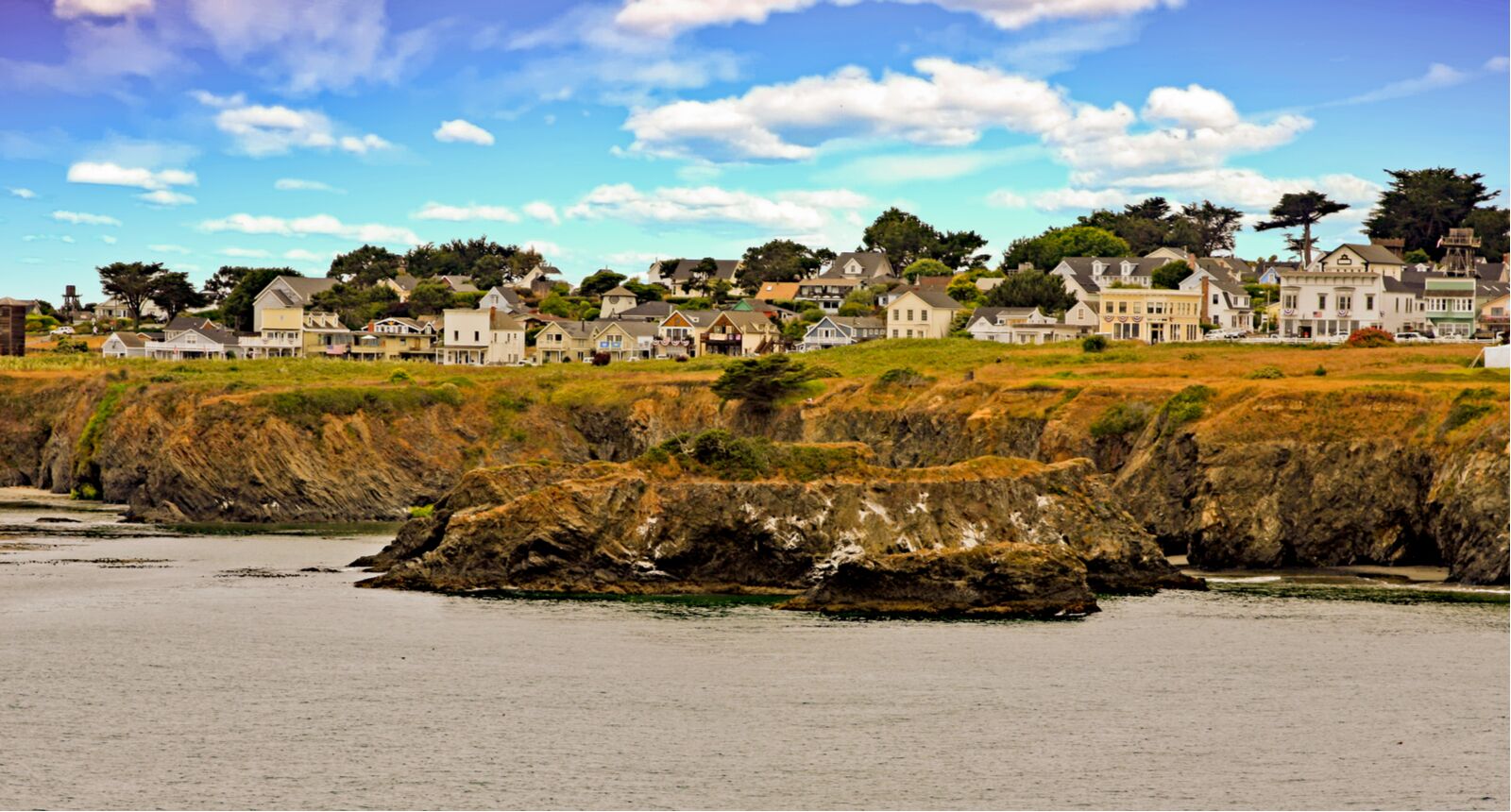
For a long weekend away from the city, head north to Mendocino. The actual town is a surprisingly small and charming village surrounded by fields overlooking the insanely beautiful cliffs Northern California is famous for. The Mendocino AVA is part of the much larger North Coast AVA, which also includes parts of several different counties, including Solano and Sonoma. There’s a lot of shade, shadow, and fog off the coast, so the region produces excellent medium-bodied reds, like syrah and pinot noirs (with a ton of variety within each).
One of the best reasons to head to Mendo for a wine weekend is the scenery. Some of the tallest trees in California are near Mendocino, and Montgomery Woods State Natural Reserve has redwoods more than 300 feet tall. Also near Mendocino are other fun activities, like the Skunk Train railway bikes through the redwoods and great mountain biking through the redwoods in Jackson State Demonstration Forest.
And when it comes to wine tasting, you have options, especially near the town of Philo. Lula Cellars is a very low-key outdoor tasting room where you’ll sit at barrel tables while tasting pinot noirs, likely with a few dogs lounging in the sun nearby. And Bonterra makes organic, climate-neutral wines — it’s the first in the world to do the latter. But Route 128 seems to have a winery every few miles once you get north of Santa Rosa, so you can pretty much pull over at whatever sign looks good and stop in for a tasting.
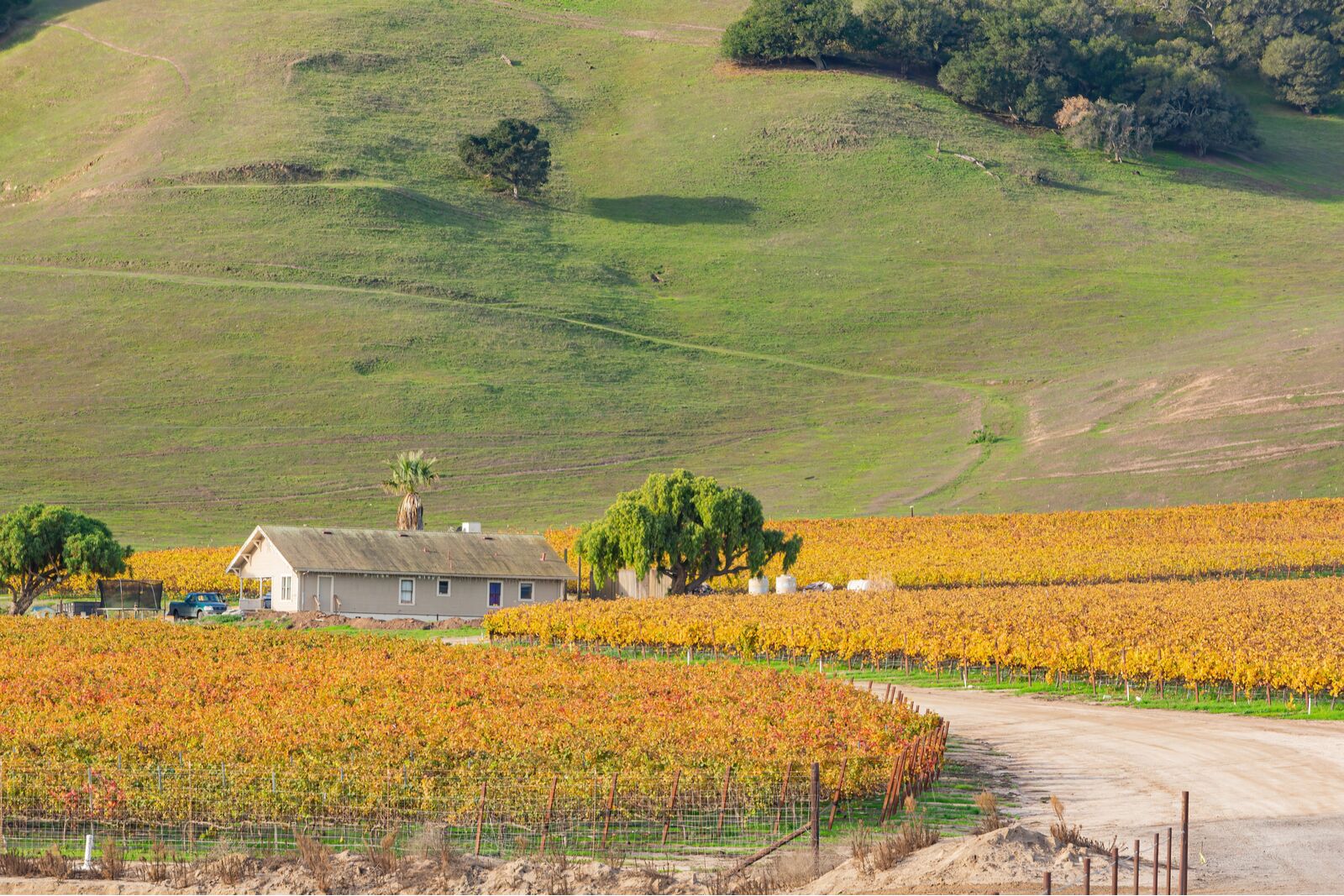
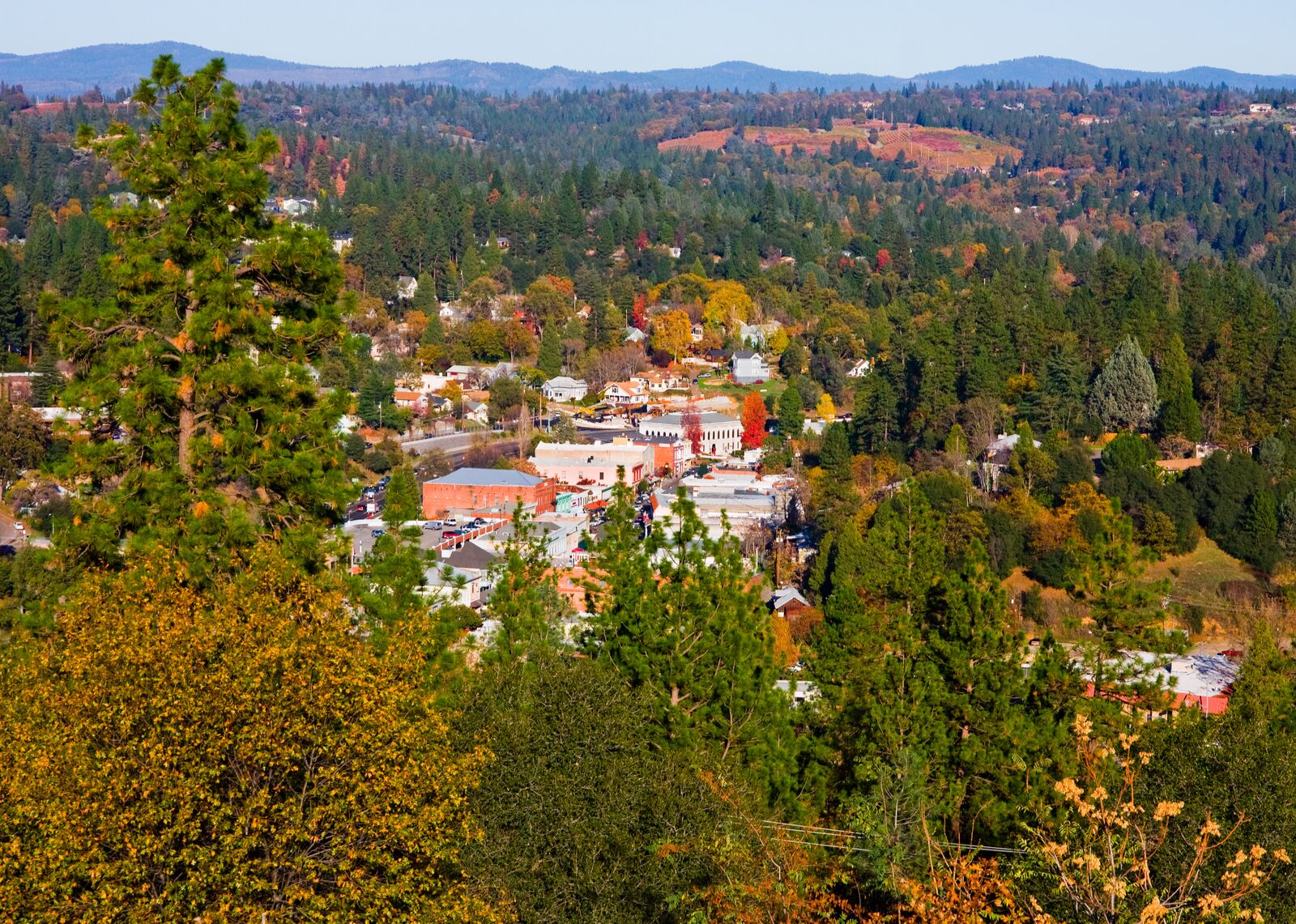
Most skiers in the Bay Area are no strangers to making the roughly three-hour drive to Lake Tahoe in the winter, but if you head in the same direction after the snow melts, you’ll reach Apple Hill in just about two hours. The rural wine region is in the foothills of the Sierra Nevada, just outside Placerville. It’s home to about 10 wineries and cideries, plus 20 ranches and farms, some of which are cute family farms that also happen to sell wine.
For a tasting and a picnic, stop by Lava Cap Winery, where full tastings are only $15. They also sell boxed cracker and cheese combos and have a large deck overlooking their vines. Rainbow Orchards is the place to get one of the apple cider donuts the region is famous for come fall, and Fenton Herriott Vineyards makes a great stop if you think wine and bocce ball is a perfect pairing.
Apple Hill will get a bit crowded on Saturdays in the fall during harvest season, but overall, it’s one of the least-crowded wine regions near San Francisco and one of the most affordable. Tastings of four or five wines are usually no more than $10 or $15, and many wineries wave the fees if you buy a bottle. It’s also casual — you’ll be walking across farms, so leave the high heels and fancy sundresses for Napa. It’s a low-key place.
Covid delayed the community event celebrating the five-year anniversary of the Lamorinda Agricultural Viticulture Area (AVA), but we’re pleased as pinot to share the news of this celebration, which goes one year better on May 1, 2022, noon-6pm, at Wine Thieves in Lafayette.
At Edible East Bay, we clearly remember the AVA’s founding, since we reported on it in this Fall 2016 story.
There’s much to enjoy at Captain Vineyards in Moraga. Photo by Olivia Vigo
David Hicks, incoming president of the Lamorinda Wine Growers Association explains, “The Lamorinda area has a deep history in wine making with the first grapes grown in the region over 150 years ago. Our rich Lamorinda soil helps produce grapes deep in color and intense in flavor, key to making great wines. We are proud that many of the wines produced in the AVA have won awards including Contra Costa Gold, San Francisco Gold, San Francisco Best of Class, Winemakers Magazine Gold and many of these will be available for tasting at our May 1 event.”
The tasting event will be complemented with food trucks offering British pub fare from The Governor and decadent grilled cheese sandwiches from The Grilled Cheez Guy. Ticket entry to the event is not required to purchase food.
Says Hicks, “We hope that our next anniversary celebration will take place in Local Vines, our tasting room that’s under construction just two doors down from Wine Thieves. Local Vines, and its partner Germinate Kitchen, are scheduled for a late 2022 opening and will be core to our community.”
Lamorinda Wine Appellation Five Year (+1) Anniversary Celebration May 1, 2022, noon–6pm Wine Thieves, 3401 Mount Diablo Boulevard, Lafayette
Tickets to the tasting event include a LWGA wine glass to keep and 5 tickets to use for tasting or a glass pour. Additional tasting tickets can be purchased for $20 for 5 tickets. Tickets purchased ahead of the day are $35 and are available on the day for $40, subject to availability. Tickets can be purchased here.
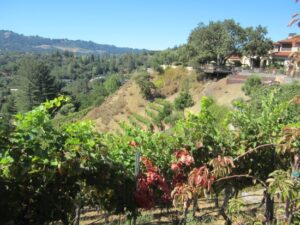
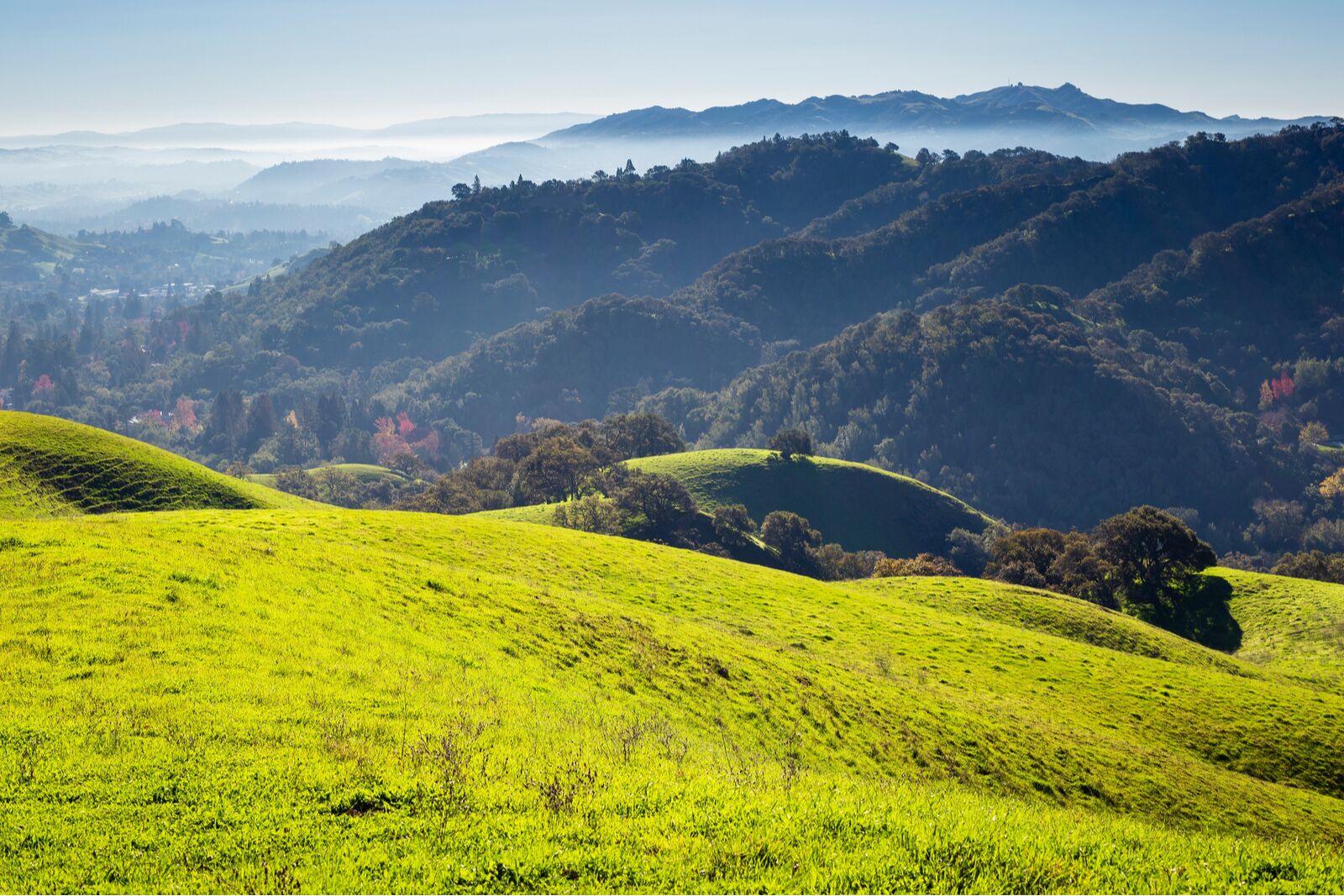
Summer’s golden hills are part of the beauty of the Lamorinda AVA’s geographical region. Photo by Olivia Vigo
DEPARTMENT OF THE TREASURY
Alcohol and Tobacco Tax and Trade Bureau
27 CFR Part 9
[Docket No. TTB–2015–0007; T.D. TTB–133; Ref: Notice No. 151]
RIN 1513–AC17
Establishment of the Lamorinda Viticultural Area
AGENCY: Alcohol and Tobacco Tax and Trade Bureau, Treasury.
ACTION: Final rule; Treasury decision.
SUMMARY: The Alcohol and Tobacco Tax and Trade Bureau (TTB) establishes the approximately 29,369-acre ‘‘Lamorinda’’ viticultural area in Contra Costa County, California. The viticultural area lies entirely within the larger San Francisco Bay viticultural area and the multicounty Central Coast viticultural area. TTB designates viticultural areas to allow vintners to better describe the origin of their wines and to allow consumers to better identify wines they may purchase.
DATES: This final rule is effective March 25, 2016.
FOR FURTHER INFORMATION CONTACT: Jesse Longbrake, Regulations and Rulings Division, Alcohol and Tobacco
Tax and Trade Bureau, 1310 G Street NW., Box 12, Washington, DC 20005; phone 202–453–1039, ext. 066.
SUPPLEMENTARY INFORMATION:
Background on Viticultural Areas
TTB Authority
Section 105(e) of the Federal Alcohol Administration Act (FAA Act), 27 U.S.C. 205(e), authorizes the Secretary of the Treasury to prescribe regulations for the labeling of wine, distilled spirits, and malt beverages. The FAA Act provides that these regulations should, among other things, prohibit consumer deception and the use of misleading statements on labels and ensure that labels provide the consumer with adequate information as to the identity and quality of the product. The Alcohol and Tobacco Tax and Trade Bureau (TTB) administers the FAA Act pursuant to section 1111(d) of the Homeland Security Act of 2002, codified at 6 U.S.C. 531(d). The Secretary has delegated various authorities through Treasury Department Order 120–01, dated December 10, 2013 (superseding Treasury Department Order 120–01, dated January 24, 2003), to the TTB Administrator to perform the functions and duties in the administration and enforcement of these provisions.
Part 4 of the TTB regulations (27 CFR part 4) authorizes TTB to establish definitive viticultural areas and regulate the use of their names as appellations of origin on wine labels and in wine advertisements. Part 9 of the TTB regulations (27 CFR part 9) sets forth standards for the preparation and submission of petitions for the establishment or modification of American viticultural areas (AVAs) and lists the approved AVAs.
Definition
Section 4.25(e)(1)(i) of the TTB regulations (27 CFR 4.25(e)(1)(i)) defines a viticultural area for American wine as a delimited grape-growing region having distinguishing features, as described in part 9 of the regulations, and a name and a delineated boundary, as established in part 9 of the regulations. These designations allow vintners and consumers to attribute a given quality, reputation, or other characteristic of a wine made from grapes grown in an area to the wine’s geographic origin. The establishment of AVAs allows vintners to describe more accurately the origin of their wines to consumers and helps consumers to identify wines they may purchase. Establishment of an AVA is neither an approval nor an endorsement by TTB of the wine produced in that area.
Requirements
Section 4.25(e)(2) of the TTB regulations (27 CFR 4.25(e)(2)) outlines the procedure for proposing an AVA and provides that any interested party may petition TTB to establish a grape- growing region as an AVA. Section 9.12 of the TTB regulations (27 CFR 9.12) prescribes standards for petitions for the establishment or modification of AVAs. Petitions to establish an AVA must include the following:
Evidence that the area within the proposed AVA boundary is nationally or locally known by the AVA name specified in the petition;
An explanation of the basis for defining the boundary of the proposed AVA;
A narrative description of the features of the proposed AVA affecting viticulture, such as climate, geology, soils, physical features, and elevation, that make the proposed AVA distinctive and distinguish it from adjacent areas outside the proposed AVA boundary; The appropriate United States Geological Survey (USGS) map(s) showing the location of the proposed AVA, with the boundary of the proposed AVA clearly drawn thereon; and
A detailed narrative description of the proposed AVA boundary based on USGS map markings.
Lamorinda Petition
TTB received a petition from Patrick L. Shabram, on behalf of the Lamorinda Wine Growers Association, proposing the establishment of the ‘‘Lamorinda’’ AVA. The proposed Lamorinda AVA is located in Contra Costa County, California, and contains the cities of Lafayette, Moraga, and Orinda. The proposed viticultural area lies in the northeast portion of the established San Francisco Bay AVA (27 CFR 9.157) and also within the larger, multicounty Central Coast AVA (27 CFR 9.75).
The proposed AVA covers approximately 29,369 acres and has 46 commercially-producing vineyards that cover approximately 139 acres. The petition states that the individual vineyards are small, each covering less than 5 acres, due to the hilly terrain and the largely suburban nature of the region. However, three much larger commercial vineyards covering a total of 130 acres are either in the early development or public review stages. There are also six bonded wineries currently within the proposed AVA.
According to the petition, the distinguishing features of the proposed Lamorinda AVA are its topography, geology, soils, and climate. The terrain of the proposed AVA is composed of moderate-to-steep hills with narrow valleys. The steep hillsides prevent the use of machinery for vineyard work within the proposed AVA, requiring instead that the work be done by hand. The proposed AVA is suitable for both cool- and warm-climate varietals because the hilly terrain results in disparate levels of sunlight at different elevations. The terrain of the proposed AVA contrasts with the steeper, more rugged terrain to the south and west and the lower, flatter plains to the north and east. Additionally, the proposed Lamorinda AVA is characterized by a distinct suburban land use pattern which tends to provide property owners with enough room to plant vineyards large enough for commercial viticulture. This contrasts with the more urban and densely populated areas to the east and west.
The dominant geological formation of the proposed Lamorinda AVA is the Orinda Formation, while the Briones and Mulholland Formations are also present. These underlying geological formations affect viticulture in the proposed AVA due to their role in forming the soils of the region. Other geographic formations dominate the surrounding area.
The soils of the proposed AVA have high levels of clay attributable to the weathering of the clay-rich Orinda Formation. Typically, clay-rich soils have high water-holding capacities, but within the proposed AVA the thinness of the soils, steepness of terrain, and presence of sand in the soils allow rapid runoff of excess water. These features reduce the risk of vineyard diseases and rot normally associated with soils with high water-holding capacities. In contrast to the clay-rich soils of the proposed AVA, the soils to the west, south, and southeast are characterized by sedimentary and volcanic materials; soils to the north are typically fine- grained bay mud; and soils to the east are characterized by deeper, coarser alluvial deposits.
Finally, the proposed Lamorinda AVA generally has a warmer climate than the surrounding areas to the north, south, and west. The high ridgelines present to the north and west of the proposed AVA limit the amount of cool marine air and fog that enters the region from San Francisco Bay, San Pablo Bay, and Suisun Bay, resulting in higher growing degree day (GDD)[1] accumulations within the region. This allows vineyards in the proposed AVA to support slower- maturing varieties of grapes which require longer growing seasons. The regions to the north, south, and west are more exposed to marine air and fog and have lower GDD accumulations than the proposed AVA. The area due east and further inland from the proposed AVA receives less marine air and fog, and experiences higher GDD accumulations than the proposed AVA.
Notice of Proposed Rulemaking and Comments Received
TTB published Notice No. 151 in the Federal Register on April 14, 2015 (80 FR 19895), proposing to establish the Lamorinda AVA. In the notice, TTB summarized the evidence from the petition regarding the name, boundary, and distinguishing features for the proposed AVA. The notice also compared the distinguishing features of the proposed AVA to the surrounding areas. For a detailed description of the evidence relating to the name, boundary, and distinguishing features of the proposed AVA, and for a detailed comparison of the distinguishing features of the proposed AVA to the surrounding areas, see Notice No. 151.
In Notice No. 151, TTB solicited comments on the accuracy of the name, boundary, and other required information submitted in support of the petition. In addition, given the proposed Lamorinda AVA’s location within the existing San Francisco Bay AVA and the larger, multicounty Central Coast AVA, TTB solicited comments on whether the evidence submitted in the petition regarding the distinguishing features of the proposed AVA sufficiently differentiates it from the existing San Francisco Bay AVA and the larger, multicounty Central Coast AVA. Finally, TTB requested comments on whether the geographic features of the proposed AVA are so distinguishable from the surrounding San Francisco Bay AVA and the larger, multicounty
Central Coast AVA that the proposed Lamorinda AVA should no longer be part of the established AVAs. The comment period closed June 15, 2015.
Comments Received
In response to Notice No. 151, TTB received a total of 12 comments. Commenters were primarily local residents and members of the wine industry from the Lamorinda region, including vineyard owners, winemakers, and a retail wine shop proprietor. Commenters also included wine industry members from outside of the Lamorinda region who work with Lamorinda-based industry members in various capacities. All of the comments generally supported the establishment of the proposed AVA due to the unique microclimates, soils, and geology of the Lamorinda region. Comments also emphasized the strong sense of community identity and commitment to local wines in Lamorinda, and suggested that the establishment of the Lamorinda AVA will help Lamorinda consumers to identify and buy local wines. Further, some comments noted that because the San Francisco Bay and Central Coast AVAs are so large and diverse, they do not necessarily reflect the specific characteristics of Lamorinda grapes and wines, and as a result, establishing the Lamorinda AVA will help wine industry members in the region differentiate themselves from others within the larger AVAs.
The comments did not raise any new issues concerning the proposed Lamorinda AVA, and TTB received no comments opposing its establishment. TTB received one comment (comment 3) in response to its question of whether the proposed Lamorinda AVA is so distinguishable from the established San Francisco Bay AVA and the Central Coast AVA that the proposed AVA should not be part of the established AVAs. While the commenter noted his belief that the proposed AVA’s combination of climate, soil, and topography is different from most, if not all, other winegrowing areas in the San Francisco Bay and Central Coast AVAs, the commenter supported finalizing the rulemaking as proposed in the interest of the expedient establishment of a Lamorinda AVA.
TTB Determination
After careful review of the petition and the comments received in response to Notice No. 151, TTB finds that the evidence provided by the petitioner supports the establishment of the Lamorinda AVA. Accordingly, under the authority of the FAA Act, section 1111(d) of the Homeland Security Act of 2002, and parts 4 and 9 of the TTB regulations, TTB establishes the ‘‘Lamorinda’’ AVA in Contra Costa County, California, effective 30 days from the publication date of this document.
TTB has also determined that the Lamorinda AVA will remain part of the established San Francisco Bay AVA and the larger, multicounty Central Coast AVA. As discussed in Notice No. 151, both the San Francisco Bay AVA and the Lamorinda AVA are characterized by climates heavily influenced by marine air and fog from San Francisco Bay and the Pacific Ocean. However, as compared to other portions of the San Francisco Bay AVA, the Lamorinda AVA is more isolated from cool marine air due to the higher surrounding elevations and is also less affected by the heavy diurnal fog that characterizes the more coastal portions of the San Francisco Bay AVA.
Further, as discussed in Notice No. 151, the large, 1 million-acre Central Coast AVA is only distinguished by the fact that all of its included counties experience marine climate influence due to their proximity to the Pacific Ocean. The Lamorinda AVA is located within the Central Coast AVA and, like the larger AVA, experiences mild marine breezes and nocturnal marine fog. However, due to its much smaller size, the proposed AVA has greater uniformity in geographical features such as topography, temperature, and soils, than the larger, multicounty Central Coast AVA.
Boundary Description
See the narrative description of the boundary of the Lamorinda AVA in the regulatory text published at the end of this final rule.
Maps
The petitioner provided the required maps, and they are listed below in the regulatory text.
Impact on Current Wine Labels
Part 4 of the TTB regulations prohibits any label reference on a wine that indicates or implies an origin other than the wine’s true place of origin. For a wine to be labeled with an AVA name or with a brand name that includes an AVA name, at least 85 percent of the wine must be derived from grapes grown within the area represented by that name, and the wine must meet the other conditions listed in 27 CFR 4.25(e)(3). If the wine is not eligible for labeling with an AVA name and that name appears in the brand name, then the label is not in compliance and the bottler must change the brand name and obtain approval of a new label. Similarly, if the AVA name appears in another reference on the label in a misleading manner, the bottler would have to obtain approval of a new label. Different rules apply if a wine has a brand name containing an AVA name that was used as a brand name on a label approved before July 7, 1986. See 27 CFR 4.39(i)(2) for details.
With the establishment of this AVA, its name, ‘‘Lamorinda,’’ will be recognized as a name of viticultural significance under §4.39(i)(3) of the TTB regulations (27 CFR 4.39(i)(3)). The text of the regulation clarifies this point. Consequently, wine bottlers using the name ‘‘Lamorinda’’ in a brand name, including a trademark, or in another label reference as to the origin of the wine, will have to ensure that the product is eligible to use the AVA name as an appellation of origin.
The establishment of the Lamorinda AVA will not affect any existing AVA, and any bottlers using ‘‘San Francisco Bay’’ or ‘‘Central Coast’’ as an appellation of origin or in a brand name for wines made from grapes grown within the San Francisco Bay AVA or the Central Coast AVA, respectively, will not be affected by the establishment of this new AVA. The establishment of the Lamorinda AVA will allow vintners to use ‘‘Lamorinda’’, ‘‘San Francisco Bay’’, and ‘‘Central Coast’’ as appellations of origin for wines made primarily from grapes grown within the Lamorinda AVA if the wines meet the eligibility requirements for the appellation.
Regulatory Flexibility Act
TTB certifies that this regulation will not have a significant economic impact on a substantial number of small entities. The regulation imposes no new reporting, recordkeeping, or other administrative requirement. Any benefit derived from the use of an AVA name would be the result of a proprietor’s efforts and consumer acceptance of wines from that area. Therefore, no regulatory flexibility analysis is required.
Executive Order 12866
It has been determined that this final rule is not a significant regulatory action as defined by Executive Order 12866 of September 30, 1993. Therefore, no regulatory assessment is required.
Drafting Information
Jesse Longbrake of the Regulations and Rulings Division drafted this final rule.
List of Subjects in 27 CFR Part 9 Wine.
The Regulatory Amendment
For the reasons discussed in the preamble, TTB amends title 27, chapter I, part 9, Code of Federal Regulations, as follows:
PART 9—AMERICAN VITICULTURAL AREAS
■ 1. The authority citation for part 9 continues to read as follows:
Authority: 27 U.S.C. 205.
Subpart C—Approved American Viticultural Areas
■ 2. Subpart C is amended by adding §9.254 to read as follows:
9.254 Lamorinda.
(a) The name of the viticultural area described in this section is ‘‘Lamorinda’’. For purposes of part 4 of this chapter, ‘‘Lamorinda’’ is a term of viticultural significance.
(b) Approved maps. The four United States Geological Survey (USGS) 1:24,000 scale topographic maps used to determine the boundary of the Lamorinda viticultural area are titled:
Walnut Creek, CA, 1995;
Las Trampas Ridge, CA, 1995;
Oakland East, CA, 1997; and
Briones Valley, CA, 1995.
(c) Boundary. The Lamorinda viticultural area is located in Contra Costa County, California. The boundary of the Lamorinda viticultural area is as described below:
The beginning point is on Walnut Creek map at the water tank (known locally as the Withers Reservoir) at the end of an unnamed light-duty road known locally as Kim Road, in the Can˜ada del Hambre y Las Bolsas Land Grant.
From the beginning point, proceed south-southeast in a straight line approximately 0.8 mile to the 833-foot peak marked ‘‘Hump 2;’’ then
Proceed southeast in a straight line approximately 1.7 miles to the marked 781-foot peak south of the shared Lafayette-Walnut Creek corporate boundary line and north of an unnamed light-duty road known locally as Peaceful Lane; then
Proceed southeast in a straight line approximately 0.3 mile to the marked 610-foot peak southwest of an unnamed light-duty road known locally as Secluded Place; then
Proceed south-southwest in a straight line approximately 1.7 miles to an unidentified benchmark at the end of an unnamed unimproved road known locally as Diablo Oaks Way in section 33, T1N/R2W; then
Proceed southeast in a straight line approximately 0.5 mile, crossing onto the Las Trampas map, and continuing another 0.9 mile to the substation at the southeast corner of section 4, T1S/R2W; then
Proceed southeast in a straight line approximately 2.3 miles to the 1,827- foot summit of Las Trampas Peak, section 22, T1S/R2W; then
Proceed south-southeast in a straight line approximately 2.1 miles to the 2,024-foot benchmark marked ‘‘Rock 2’’ in section 26, T1S/R2W; then
Proceed west-southwest in a straight line approximately 2.7 miles to the marked 1,057-foot peak in section 29, T1S/R2W; then
Proceed west-southwest in a straight line approximately 2 miles to the intersection of the 1,000-foot elevation line with the Contra Costa– Alameda County line in section 31, T1S/R2W; then
Proceed northwest in a straight line approximately 0.4 mile, crossing onto the Oakland East map, then continuing another 0.1 mile to the 1,121-foot peak in section 30, T1S/R2W; then
Proceed northwest in a straight line approximately 3.6 miles to the 1,301-foot peak in section 15, T1S/R3W; then
Proceed northwest in a straight line approximately 1.6 miles to the 1,634-foot peak in section 9, T1S/R3W; then
Proceed northwest in a straight line approximately 2.2 miles to the communication tower on the Contra Costa-Alameda County line in section 5, T1S/R3W; then
Proceed north in a straight line approximately 0.1 mile, crossing onto the Briones Valley map, then continuing another 0.6 mile to the 1,905-foot summit of Vollmer Peak in the El Sobrante Land Grant; then
Proceed north-northeast in a straight line approximately 3 miles, crossing over to the 1,027-foot peak in the Boca de la Cañada del Pinole Land Grant, to the Orinda corporate boundary line; then
Proceed generally east along the Orinda corporate boundary line approximately 3.3 miles to the water tank at the 1,142-foot elevation in the Boca de la Can˜ada del Pinole Land Grant; then
Proceed east-northeast in a straight line approximately 1.2 miles to the 1,357-foot benchmark marked ‘‘Russell’’ in the Boca de la Can˜ada del Pinole Land Grant; then
Proceed northwest in a straight line approximately 0.8 mile to the 1,405-foot peak in the Boca de la Can˜ada del Pinole Land Grant; then
Proceed east-northeast in a straight line approximately 0.5 mile, crossing onto the Walnut Creek map, then continuing another 1.1 miles to the beginning point.
Signed: January 11, 2016. John J. Manfreda, Administrator.
Approved: January 22, 2016.
Timothy E. Skud,
Deputy Assistant Secretary, (Tax, Trade, and Tariff Policy).
[FR Doc. 2016–03860 Filed 2–23–16; 8:45 am]
BILLING CODE 4810–31–P
[1] In the Winkler climate classification system, annual heat accumulation during the growing season, measured in annual GDDs, defines climatic regions. One GDD accumulates for each degree Fahrenheit that a day’s mean temperature is above 50 degrees, the minimum temperature required for grapevine growth. See Albert J. Winkler, General Viticulture (Berkeley: University of California Press, 1974), pages 61–64.